
How to scale ad spend without breaking ROAS
Doubling the budget rarely doubles the sales. Scaling works when you add spend in steps, open new demand instead of squeezing old demand, and watch the right numbers.
Key takeaways
- Scale only when tracking is clean and unit economics work at higher spend.
- Raise budgets in steps, wait, then check. Big jumps cause big swings.
- Scale horizontally too: new campaigns, products, channels and creative concepts.
- Judge scaling on marginal return and MER, not on account-wide ROAS alone.
Every growing brand hits the same moment. A campaign is working, so someone doubles the budget. A week later ROAS has fallen, panic sets in, and the budget is cut back. Nothing was learned. Here is the order we follow instead.
Why returns fall as you spend more
Ads reach the most likely buyers first. Each extra rupee reaches someone slightly less ready to buy. So as spend rises, the cost of each extra sale rises too. This is normal and is called diminishing returns.
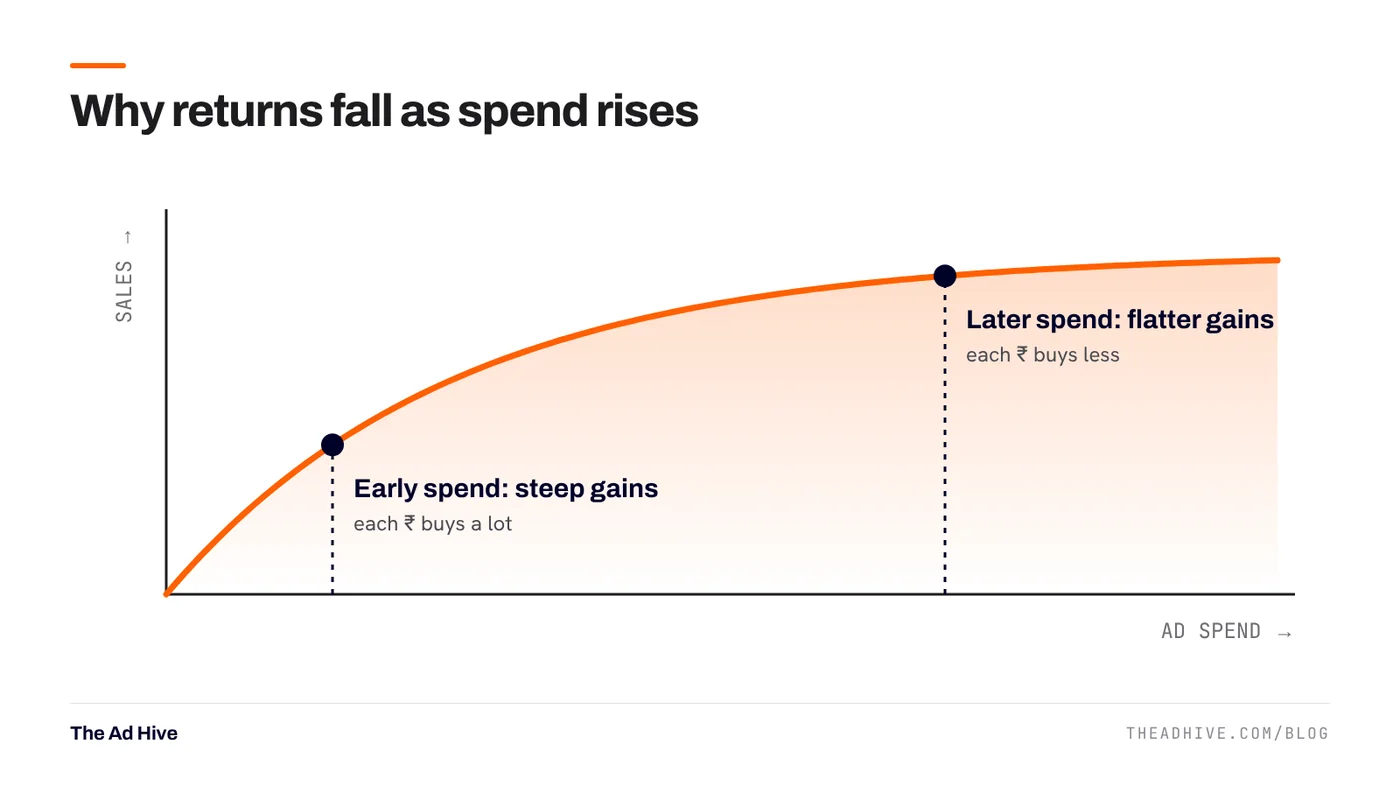
The goal isn’t to keep ROAS flat while spending more. It’s to keep adding spend while each extra sale is still profitable.
Step 0: are you ready to scale?
- Tracking is clean. If purchases are double counted, scaling on that data scales the error. See our audit checklist.
- You know your break-even. Work out break-even ROAS or MER from your margins first. Our ROAS vs MER vs POAS guide shows how.
- Operations can keep up. Stock, delivery and customer service must handle more orders.
- Performance is stable for at least a few weeks, not one lucky week.
Vertical scaling: more budget on what works
On Google
- Raise budgets on campaigns that are limited by budget and above target.
- Remember Google can spend up to 2× the average daily budget on a single day, and up to 30.4× it over a month. A budget change shows up in spend gradually.
- If you use Target ROAS, lower the target a little to win more volume rather than only raising budget. Google says a target that’s too high limits traffic. Move it in small steps and allow one to two conversion cycles between changes. Our Target ROAS guide covers this in detail.
- Check search impression share. If you’re already showing for most eligible searches, more budget won’t buy much more.
On Meta
- Raise budgets in steps rather than big jumps. Large edits can send an ad set back into the learning phase, according to Meta’s help centre.
- Scale the campaigns with strong new-customer share, not just strong ROAS.
- Add fresh creative as you scale. More spend on the same ads raises frequency and fatigue.
Our rule of thumb on both platforms: increases of roughly 15–25%, then wait several days and review. It’s not a platform rule, just what keeps results readable.
Horizontal scaling: open new demand
Vertical scaling squeezes more from the same demand. Horizontal scaling finds new demand. Most brands need both.
- New products or categories in Shopping and Performance Max, with feeds fixed first.
- New keyword themes found in search terms and competitor research.
- New creative concepts on Meta, which reach new pockets of people. See our creative testing framework.
- New channels: Demand Gen on YouTube and Discover, as in our Demand Gen guide. Google recommends a daily budget of at least 10× target CPA there.
- New markets, once the home market is close to saturated.
What to watch while scaling
| Metric | Why it matters |
|---|---|
| Marginal ROAS | Extra value ÷ extra spend since the last step. Shows if the new money works. |
| MER | Total store sales ÷ total spend. Catches overlap between platforms. |
| New-customer share | Scaling that only reaches existing buyers isn’t growth. |
| Frequency (Meta) | Rising fast means the same people see the same ads too often. |
| Impression share (Google) | Shows how much search demand is left to capture. |
Stop scaling when marginal return falls below your break-even, not when account ROAS dips below last month’s. Last month’s ROAS was at a lower spend; it isn’t the right benchmark.
Scaling plans are a core part of our PPC management and e-commerce consulting. If you’re not sure the account is ready, start with a forensic PPC audit.
Frequently asked questions
How much can I increase my ad budget at once?
There is no official safe percentage. We usually raise budgets in steps of about 15 to 25 percent, then wait several days before the next step, so bidding can adjust and you can see the effect.
Why does ROAS drop when I increase budget?
The first rupees reach the most likely buyers. Extra spend reaches people who are less ready to buy, so each extra sale costs more. Some drop is normal. The question is whether the extra sales are still profitable.
Should I scale on Google or Meta first?
Scale where you have unmet demand and headroom. If search impression share is low on profitable terms, Google first. If you've captured most search demand, add Meta or Demand Gen to create new demand.
Sources
- Google Ads Help: About average daily budget
- Google Ads Help: About Target ROAS bidding
- Google Ads Help: About Demand Gen campaigns
- Meta Business Help Center: About the learning phase
Sources checked on 15 November 2026. Platform features change often; check the linked pages for the latest details.
Want this done on your account?
We manage Google and Meta ads for e-commerce, D2C and lead-gen brands. Every engagement starts with a manual review of what is already running.
Related guides
Target ROAS bidding: how to set it, when to change it, and the mistakes that kill volume
Target ROAS is the bid strategy most e-commerce accounts end up on. Set it from your margins, move it slowly, and judge it on more than…

Demand Gen campaigns for e-commerce: a practical setup guide
Demand Gen is Google's answer to social-style advertising: visual ads on YouTube, Shorts, Discover and Gmail. With Display moving into it from 2026, every e-commerce brand…
ROAS vs MER vs POAS: which number should run your ad budget?
ROAS tells you what a platform claims. MER tells you what the business got. POAS tells you whether you made money. You need all three, used…