ChatGPT Ads in India: how they work, who can run them and how to test them
OpenAI opened self-serve ChatGPT Ads to Indian advertisers on 31 August 2026. Here is what the ads are, who sees them, which categories are off-limits, and how to test the channel without wasting budget.
Key takeaways
- Self-serve ChatGPT Ads opened in India on 31 August 2026, through OpenAI’s Ads Manager.
- Ads show below answers, labelled as sponsored, to users on the Free and Go plans.
- Many categories can’t advertise. Outside the US that generally includes healthcare and legal services.
- Set up tracking first, use a fixed test budget, and decide on real sales or leads.
For twenty years, paid search meant Google. Now a growing share of product research starts with a question typed into ChatGPT. In 2026 OpenAI started selling ads there, and on 31 August 2026 it opened self-serve buying to advertisers in India.
This guide covers what we know from OpenAI’s own announcements and policies, and how we would test the channel for a client.
How ChatGPT Ads got here
- 16 January 2026: OpenAI said it would test ads at the bottom of answers for Free and Go users in the US, shown only when a sponsored product or service is relevant to the conversation.
- 5 May 2026: OpenAI started rolling out a self-serve Ads Manager in beta, added cost-per-click buying alongside cost-per-impression, and launched a pixel and a Conversions API to measure purchases, leads and sign-ups.
- 31 August 2026: self-serve buying opened in India, Europe, the Middle East and North Africa.
- 21 October 2026: OpenAI said ChatGPT Ads now reach 89 countries, and that only Free and Go users see ads. Plus, Pro and Enterprise stay ad-free.
How the ads work
- Placement: an ad card below ChatGPT’s answer, labelled as sponsored.
- Relevance: ads show when a sponsored product or service fits the conversation.
- Buying: you set budgets, bids and pacing in Ads Manager, and pay per click or per thousand impressions.
- Privacy: OpenAI says advertisers don’t see anyone’s conversations and only get aggregated results.
- Answers: OpenAI says advertising doesn’t influence ChatGPT’s answers.
In practice this behaves more like search than social. The person has just asked for something. A good ad answers the next question they would ask.
Who can’t advertise
Check this before anything else. OpenAI’s ad policies prohibit, among others:
- Adult content and dating
- Alcohol, tobacco and recreational drugs
- Gambling, including betting and cash-prize games
- Political content and government ads
- Unproven wellness claims, such as diet pills or detox programmes
- Individual job listings and housing rentals or sales
Some categories are restricted by country. Healthcare ads are generally not allowed outside the US, legal services ads are not allowed outside the US, and financial services ads outside the US need OpenAI’s approval. For many Indian clinics, insurers, lenders and law firms, that rules the channel out for now.
Ads also don’t show next to some conversations, such as health, mental health and politics, or when someone seems vulnerable. Landing pages must match the ad, clearly identify the business, and can’t link straight into a chat app.
How to run a fair first test
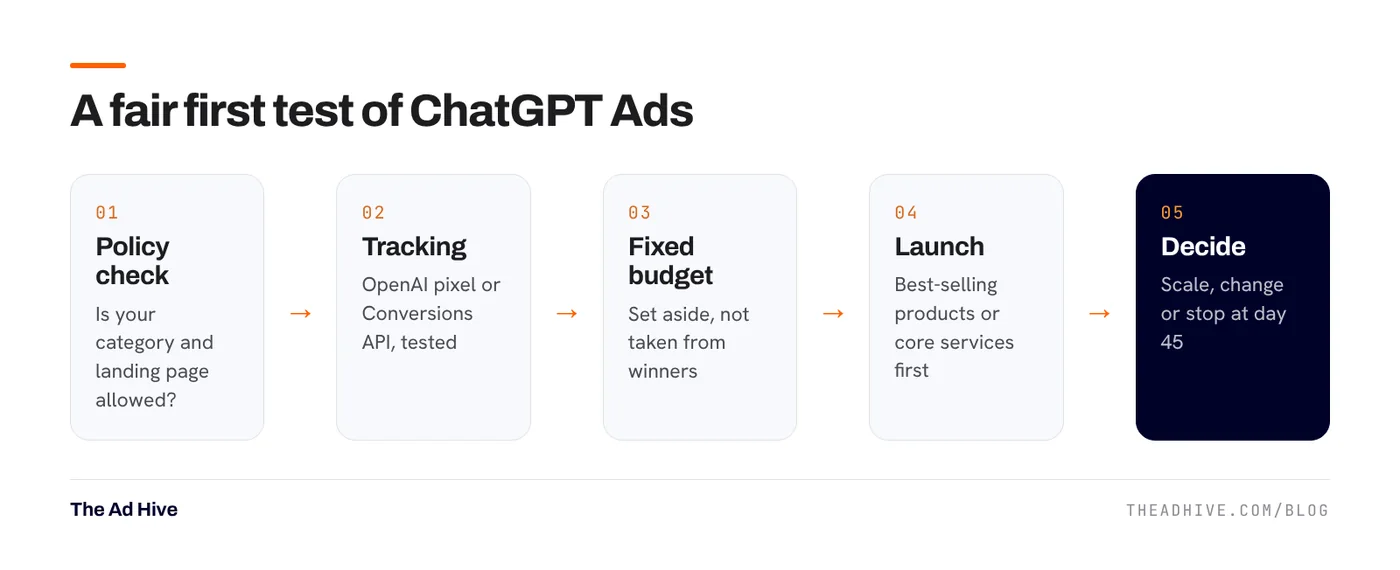
- Check policy. Read the current ad policies against your category, offer and landing pages.
- Set up tracking. Install OpenAI’s pixel or Conversions API for the action that matters: a purchase, a qualified lead or a sign-up. Add tagged links so the traffic shows clearly in GA4.
- Ring-fence the budget. Use a fixed test budget. Don’t fund it by cutting a Google or Meta campaign that already pays back.
- Start with what sells. Pick your best-selling products or core services, where you already know the margins and conversion rates.
- Write for the conversation. Answer the shopper’s next question: price, delivery time, who it’s for, proof.
- Decide on a date. Agree a success rule before launch, then at around day 45 decide to scale, change or stop.
How to judge the results
ChatGPT’s reported conversions are ChatGPT-attributed results. Label them that way. Then check them against what your store, CRM or GA4 saw in the same period.
Compare cost per sale or cost per qualified lead with Google Search for the same products. If ChatGPT Ads bring customers at a similar or better cost, and those customers aren’t simply people who would have found you on Google anyway, the channel deserves more budget. Our ROAS, MER and POAS guide covers how to tell.
The channel is only months old in India. OpenAI hasn’t published typical click costs or conversion rates for Indian advertisers. Treat any “average ChatGPT ROAS” you see online with caution, and build your own baseline from your own test.
Where ChatGPT Ads fit
For most brands, ChatGPT Ads sit next to Google Search, not in place of it. Keep your search campaigns, AI Max tests and conversion tracking in good shape. Add ChatGPT as a measured test once those are working.
Want a hand with your first test? See our ChatGPT Ads agency page or our Google Ads team.
Frequently asked questions
Can Indian businesses run ChatGPT ads?
Yes. OpenAI opened its self-serve Ads Manager to advertisers in India on 31 August 2026. You register, add payment details, set budgets and bids, upload ads and launch.
Do ChatGPT ads change ChatGPT's answers?
OpenAI says no. It says ads are clearly labelled, kept separate from answers, and that advertising does not influence what ChatGPT says.
Can healthcare or finance brands advertise on ChatGPT?
Not easily outside the US. OpenAI's ad policies generally don't allow healthcare ads outside the US, don't allow legal services ads there, and financial services ads outside the US need OpenAI's approval. Check the current policy before you plan a test.
Sources
- OpenAI: Our approach to advertising and expanding access to ChatGPT (16 Jan 2026)
- OpenAI: New ways to buy ChatGPT ads (5 May 2026)
- OpenAI: A milestone in expanding access to AI with ChatGPT ads (31 Aug 2026)
- OpenAI: ChatGPT Ads expands to 26 new countries (21 Oct 2026)
- OpenAI: Ad policies
Sources checked on 25 November 2026. Platform features change often; check the linked pages for the latest details.
Want this done on your account?
We manage Google and Meta ads for e-commerce, D2C and lead-gen brands. Every engagement starts with a manual review of what is already running.
Related guides
ROAS vs MER vs POAS: which number should run your ad budget?
ROAS tells you what a platform claims. MER tells you what the business got. POAS tells you whether you made money. You need all three, used…
AI Max for Search campaigns: what it changes and how to test it safely
AI Max is not a new campaign type. It is a layer you switch on inside a Search campaign, and it can reach searches your keywords…
Enhanced conversions and Consent Mode: fix Google Ads tracking before you touch bids
Smart Bidding is only as good as the conversions it sees. Enhanced conversions recover lost sales; Consent Mode keeps measurement working when people decline cookies. Here…