
Demand Gen campaigns for e-commerce: a practical setup guide
Demand Gen is Google's answer to social-style advertising: visual ads on YouTube, Shorts, Discover and Gmail. With Display moving into it from 2026, every e-commerce brand should know how it works.

Key takeaways
- Demand Gen runs visual ads on YouTube, Shorts, Discover, Gmail and the Display network.
- It is built to create demand, so judge it differently from Search.
- Google recommends a daily budget of at least 10× your target CPA.
- Display campaigns are moving into Demand Gen from June 2026.
Search captures people who already want what you sell. Demand Gen reaches people who don’t know they want it yet. For e-commerce brands that rely only on Search and Shopping, it is often the missing piece. It is also the campaign type most often set up badly.
What Demand Gen is
Demand Gen is a Google Ads campaign type for image, video and product ads on Google’s visual surfaces. Google says it can reach up to 3 billion monthly active users.
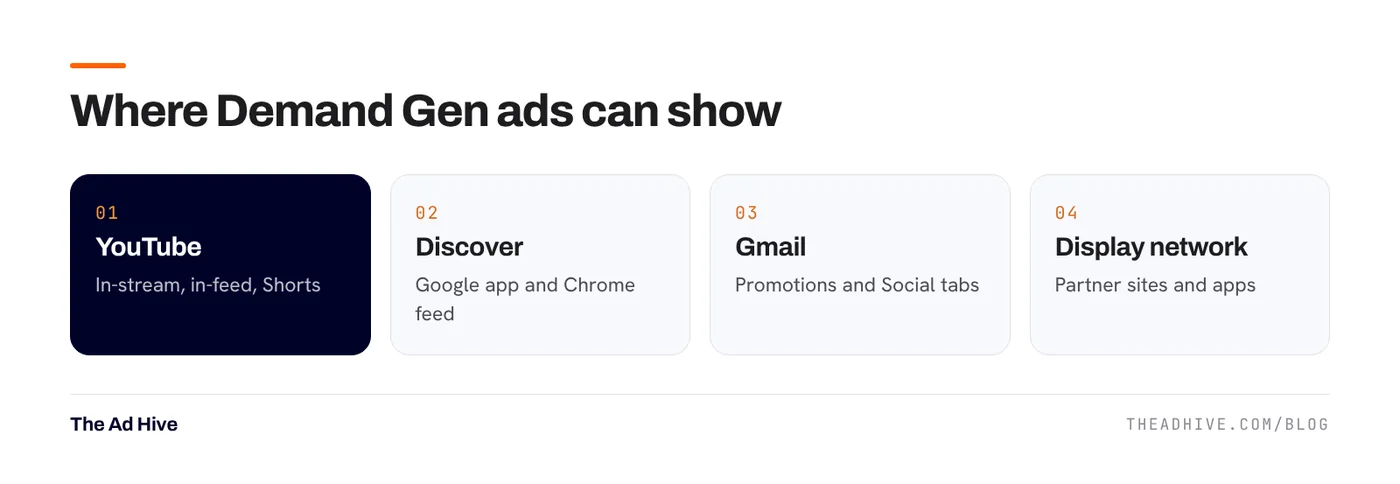
Google is also folding Display into it. Eligible advertisers can migrate Display campaigns to Demand Gen from June 2026, and new Display network campaigns will be built inside Demand Gen.
Channel controls
You can choose where ads run. Options include YouTube Shorts, in-feed, Home feed and watch-next placements, plus Discover, Gmail and the Display network. For example, you can run vertical video on Shorts only.
Our default: start with all Google-owned channels, then check the channel split after two to three weeks. Remove a channel only when it has had enough spend to judge.
Assets that work
Demand Gen supports:
- Images: landscape (1.91:1), square (1:1), portrait (4:5) and a square logo.
- Video: landscape, square and vertical.
- Carousels: 2–10 image cards.
- Product feeds from Merchant Center, so product cards can sit under your video.
Google says mixing images and video usually performs better than one format alone. Build each ad around a clear idea: a problem, a product in use, a customer result. The thinking from our Meta creative testing framework applies here too: different concepts beat small tweaks.
Creative checklist
- Show the product in the first two seconds of video.
- Use vertical video for Shorts. Don’t crop a landscape ad.
- Add captions. Many people watch without sound.
- Avoid “fake button” designs. Google can mark ads “Eligible (limited)” for implied interactivity, and they won’t serve.
Audiences
Lookalike segments are the main targeting tool. You build them from people who bought, visited your site or watched your YouTube videos. They help you reach new people who resemble your customers.
Good seed lists for e-commerce:
- Past purchasers (best quality, needs volume).
- High-value customers, if you can segment them.
- Recent site visitors, for a broader seed.
Exclude existing buyers from prospecting campaigns, or you’ll pay to reach people who already know you.
Bidding and budget
Demand Gen supports bidding for clicks, conversions or conversion value. Two rules from Google matter most:
- For Target CPA, set a daily budget of at least 10× your target CPA.
- For Target ROAS, the campaign needs at least 50 conversions in the past 35 days, or 100 across the account.
If you don’t have that volume, Google suggests optimising toward a lighter event, like add to cart, while the campaign learns. Don’t set a target CPA far below your historical average. It will stop delivery.
How to judge Demand Gen
Demand Gen is upper funnel. Many people see an ad, then search for your brand days later. Last-click reports will undervalue it.
What we look at:
- Branded search volume before and during the campaign.
- New customers in your store data, not just platform conversions.
- Blended efficiency, like MER (total sales ÷ total ad spend). See ROAS vs MER vs POAS.
- Lift tests where you qualify. Google offers search lift and conversion lift studies.
Demand Gen depends on conversion data and Consent Mode signals to learn. If your Google tag or enhanced conversions are broken, fix them first. Our enhanced conversions guide explains how.
When to start
Add Demand Gen once Search and Shopping are running well and you have creative ready. If you are hitting the limits of search demand, it is the natural next step. Our PPC management team builds Demand Gen into the plan once the basics are proven, and our scaling guide explains the order we follow.
Frequently asked questions
What is the difference between Demand Gen and Performance Max?
Performance Max runs across all Google channels including Search and Shopping. Demand Gen focuses on visual placements: YouTube, Shorts, Discover, Gmail and the Display network. It suits creating demand rather than capturing existing searches.
What budget does Demand Gen need?
For Target CPA bidding, Google recommends a daily budget of at least 10 times your target CPA. Smaller budgets struggle to give the system enough data.
Are Display campaigns being replaced by Demand Gen?
Google says Display campaigns are moving to Demand Gen. Eligible advertisers can migrate from June 2026, and new Display network campaigns will be created within Demand Gen.
Sources
Sources checked on 15 November 2026. Platform features change often; check the linked pages for the latest details.
Want this done on your account?
We manage Google and Meta ads for e-commerce, D2C and lead-gen brands. Every engagement starts with a manual review of what is already running.
Related guides

Performance Max best practices for 2026: how to get control back
Performance Max used to be a black box. In 2025 and 2026 Google added the controls advertisers kept asking for. Here is how to use them…

A creative testing framework for Meta ads that works after Andromeda
The old way of testing Meta ads, one variable at a time in tiny ad sets, fights how Meta now delivers ads. Here is the testing…
Target ROAS bidding: how to set it, when to change it, and the mistakes that kill volume
Target ROAS is the bid strategy most e-commerce accounts end up on. Set it from your margins, move it slowly, and judge it on more than…