
ACOS vs TACoS on Amazon: how to read them and set targets
ACOS tells you how efficient your Amazon ads are. TACoS tells you whether they're growing the business. Read them together and you'll know when to push and when to pull back.
Key takeaways
- ACOS (advertising cost of sales) = ad spend ÷ ad sales × 100. Lower is more efficient.
- Break-even ACOS equals your profit margin before ad costs.
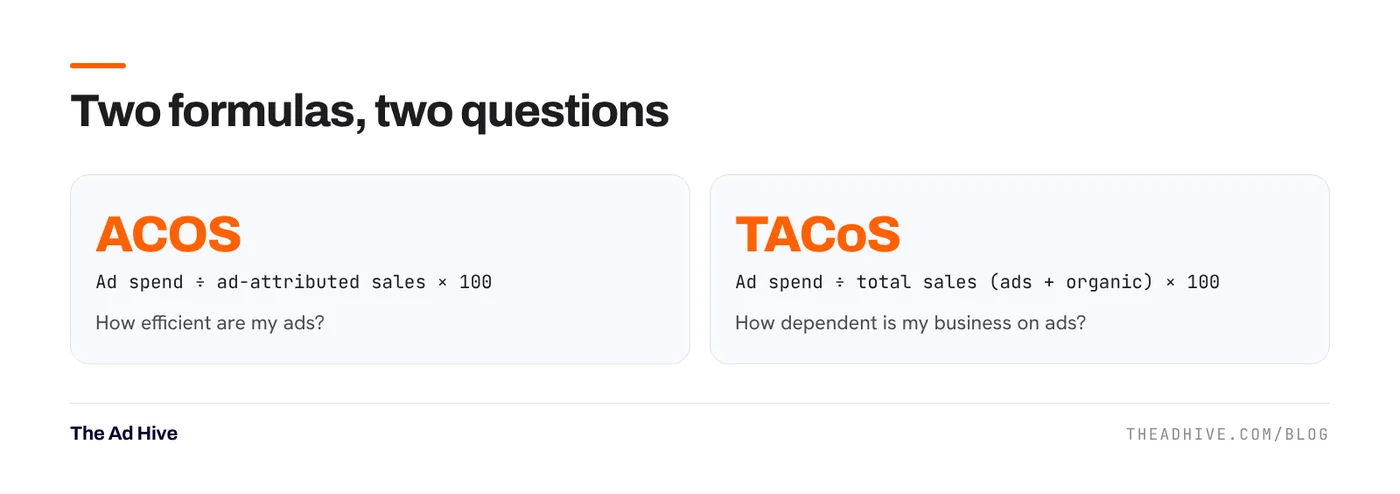
- TACoS (total advertising cost of sales) = ad spend ÷ total sales × 100. It shows ad dependence.
- Rising ACOS with falling TACoS can be healthy: ads are lifting organic sales too.
Amazon sellers live by ACOS. But ACOS alone can push you into a corner: cut spend to improve it, lose ranking, lose organic sales, and end up smaller but “more efficient”. Reading ACOS with TACoS prevents that.
ACOS: Amazon’s efficiency metric
Amazon defines it as:
ACOS = (ad spend ÷ ad revenue) × 100
Amazon’s own example: spend $50 to earn $100 in ad sales and ACOS is 50%. ROAS is the inverse, 2.
Amazon is clear there’s no universal “good” ACOS. It depends on your category, size and goals. New campaigns often show high ACOS simply because they’re new.
Break-even ACOS
Amazon’s advice is to first reach break-even ACOS and compare it with your profit margin. To stay profitable on ad-driven sales, ACOS must be lower than your margin.
Worked example:
| Line | Per unit |
|---|---|
| Selling price (after discounts) | ₹1,000 |
| Product cost | ₹350 |
| Amazon fees and shipping | ₹300 |
| Profit before ads | ₹350 |
| Break-even ACOS | 35% |
At 35% ACOS each ad sale breaks even. At 25% you keep ₹100 per ad sale. At 45% you lose ₹100 on each ad sale, which may still be fine during a launch if it builds ranking and reviews.
TACoS: the business metric
TACoS = (ad spend ÷ total sales) × 100, where total sales includes organic sales. TACoS isn’t shown as a standard column in every Amazon report, so most sellers calculate it from Seller Central sales and ads console spend.
Example: ₹2,00,000 ad spend, ₹6,00,000 ad sales, ₹20,00,000 total sales.
- ACOS = 2,00,000 ÷ 6,00,000 = 33.3%
- TACoS = 2,00,000 ÷ 20,00,000 = 10%
Reading them together
| ACOS | TACoS | What it usually means |
|---|---|---|
| Rising | Falling | Ads are lifting organic rank and sales. Often healthy. |
| Rising | Rising | Ads cost more without lifting the business. Investigate. |
| Falling | Falling | Efficiency and organic strength improving. Room to scale. |
| Falling | Rising | Organic sales shrinking. Check rank, reviews, stock and competitors. |
Setting targets by goal
- Launch: accept ACOS above break-even for a set period to build ranking and reviews. Watch TACoS trend down as organic grows.
- Growth: target ACOS near break-even on discovery campaigns, lower on brand and best sellers.
- Profit: target ACOS well below margin and hold TACoS steady.
ACOS and TACoS map closely to ROAS and MER on Google and Meta. If you run both, our ROAS vs MER vs POAS guide shows how to keep one set of definitions across channels.
Common mistakes
- One ACOS target for every product. Margins differ, so targets should too.
- Cutting brand defence to lower ACOS. Competitors will happily take those shoppers.
- Ignoring the listing. Weak images, titles and reviews raise ACOS no matter how good the bids are. The same principles as our Shopping feed guide apply.
- Using Amazon for lead-gen. Amazon Ads is for selling products. It isn’t a lead-gen channel.
We run Amazon alongside Google and Meta for e-commerce brands, so the numbers line up across channels. See our e-commerce consulting, or start with a forensic PPC audit. For scaling, read how to scale ad spend.
Frequently asked questions
What is a good ACOS on Amazon?
Amazon says there's no universal good ACOS. Start with break-even ACOS, which equals your profit margin before ad costs. To stay profitable on ad-driven sales, ACOS needs to be below that margin.
What is the difference between ACOS and TACoS?
ACOS divides ad spend by sales attributed to ads. TACoS divides the same ad spend by all sales, including organic. TACoS shows whether advertising is lifting the whole business.
Can Amazon Ads be used for lead generation?
No. Amazon Ads is built for selling products on and off Amazon. For lead generation, Google Search and, for B2B, LinkedIn are better fits.
Sources
Sources checked on 15 November 2026. Platform features change often; check the linked pages for the latest details.
Want this done on your account?
We manage Google and Meta ads for e-commerce, D2C and lead-gen brands. Every engagement starts with a manual review of what is already running.
Related guides
ROAS vs MER vs POAS: which number should run your ad budget?
ROAS tells you what a platform claims. MER tells you what the business got. POAS tells you whether you made money. You need all three, used…
How to scale ad spend without breaking ROAS
Doubling the budget rarely doubles the sales. Scaling works when you add spend in steps, open new demand instead of squeezing old demand, and watch the…

Google Shopping feed optimisation: the fixes that lift clicks and sales
In Shopping and Performance Max, your product feed does the job keywords do in Search. Better titles and complete attributes are often the cheapest growth lever…