Meta Andromeda explained: why your creative is now your targeting
Andromeda is the system Meta uses to pick which ads could be shown to each person. It changed what works on Meta, and many accounts felt it before they understood it.
Key takeaways
- Andromeda is Meta’s retrieval system: the first filter that picks which ads could be shown to each person.
- Meta says it now scores every eligible ad, using signals from the ad itself.
- A few near-identical ads give it little to work with. Distinct concepts give it more.
- Simpler structures with broad targeting and more creative variety usually suit it best.
Since 2025 we’ve heard the same worry from brand after brand: “Our Meta ads stopped working and nothing changed on our side.” Often something did change, just not in their account. Meta changed how it picks which ads to show. That system is called Andromeda.
What Andromeda is
Meta’s ad system works in stages. Andromeda is the first one, called retrieval. For each person scrolling, it narrows a huge pool of eligible ads down to a few thousand. Bigger ranking models then score those few thousand and the auction picks a winner.
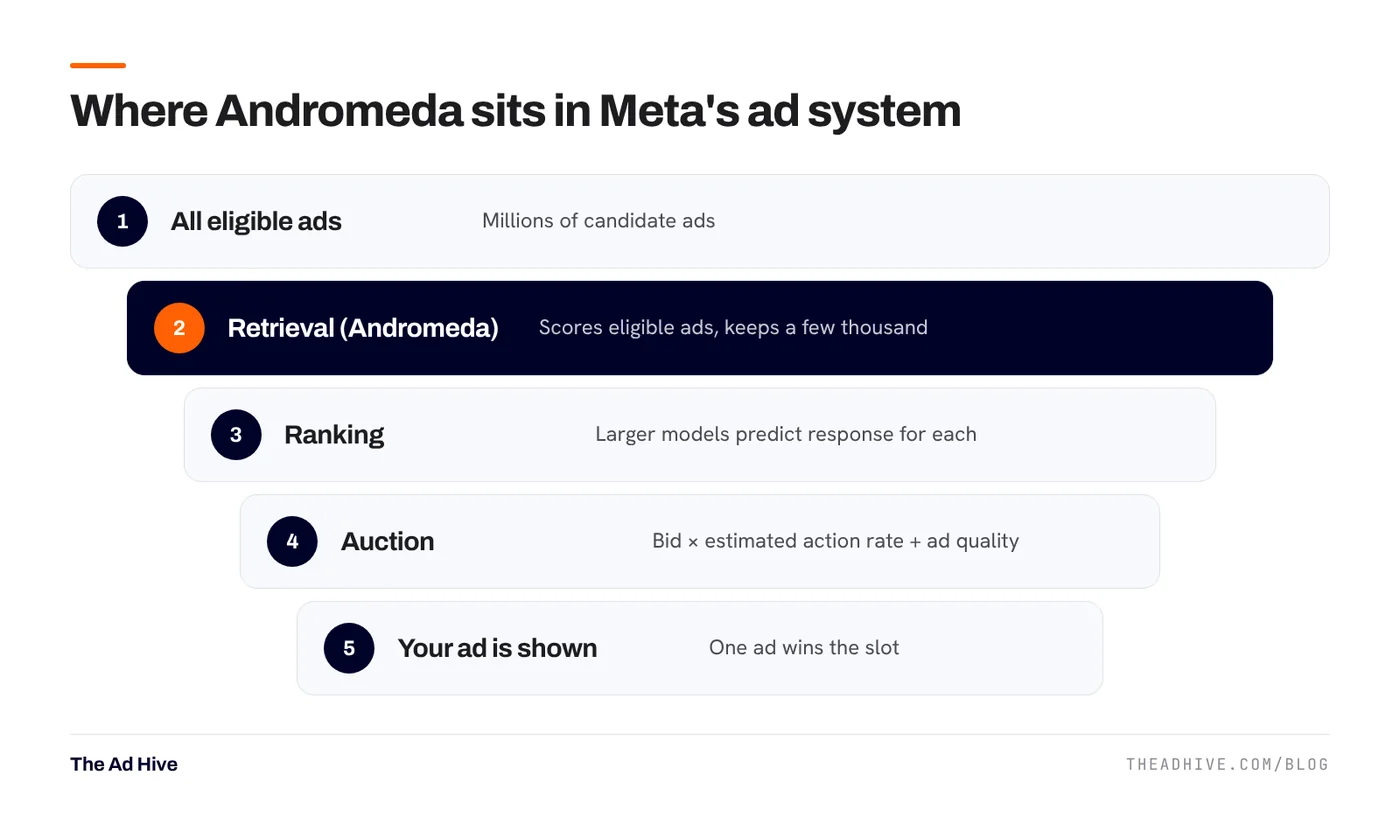
If an ad isn’t picked at retrieval, it never reaches the auction. That is why Andromeda matters even though most advertisers never see it.
What Meta has said about it
December 2024: launch
Meta’s engineering team announced Andromeda in December 2024. They reported a 6% improvement in recall (finding the right ads) and an 8% improvement in ads quality on selected segments. They also said they expected the number of ads in the system to grow fast as advertisers used generative AI tools. At that point, Meta said over a million advertisers had used its generative AI tools to create more than 15 million ads in a month.
October 2026: second generation
In October 2026 Meta described a rebuilt version. The claims that matter to advertisers:
- It “scores every eligible ad”, rather than a sample.
- Meta says that since 2025, Andromeda has delivered a 2.4% increase in conversions on Facebook. Meta did not publish a baseline or method, so treat it as Meta’s own figure.
- Generative AI tools helped advertisers create “hundreds of millions” of new ads, and Meta expects the pool to keep growing.
What it means for your account
1. Creative is doing the targeting
Andromeda matches people to ads using what is in the ad. A video about back pain relief and a video about gifting will find different people, even with the same audience settings. Your creative mix now shapes who sees you far more than interest lists do.
2. Ten versions of one idea count as one idea
Changing the headline colour or swapping one line of text gives the system almost nothing new. Ads that look alike tend to be treated alike. Real variety means different angles, formats, people and hooks. Our creative testing framework shows how to build that variety on purpose.
3. Fewer, bigger ad sets
Splitting budget across many small ad sets with narrow audiences limits what retrieval can do. Most accounts we manage now run a small number of campaigns with broad targeting and many creatives. Advantage+ sales campaigns are built for this.
4. Signal quality matters more
The system learns from your conversion data. Missing or duplicated purchase events teach it the wrong lessons. Set up the Conversions API properly and check Event Match Quality.
A simple Andromeda-ready setup
- One prospecting sales campaign with broad targeting or Advantage+ audience, limited only by country and age where needed.
- Exclude or cap existing customers if you want new-customer growth.
- 8–15 live ads built on different concepts, mixing static, video and carousel.
- A steady supply of new concepts, added every week or two.
- Clean tracking: pixel plus Conversions API, deduplicated.
When results dip, the urge is to change budgets, audiences and ads all at once. Each big change can restart learning. Change one thing, wait, then judge. Also remember Meta changed its reporting windows in January 2026, which can make results look different on paper. See our Meta attribution guide.
What hasn’t changed
The offer, the product page and the price still decide whether people buy. Andromeda can find better buyers, but it can’t fix a weak offer or a slow site. Check your landing page before blaming the algorithm.
If your Meta results dropped and you’re not sure why, our forensic PPC audit reviews structure, creative mix and tracking line by line, and our PPC management team can take it from there.
Frequently asked questions
What is Meta Andromeda in simple terms?
It is the first filter in Meta's ad system. For each person, it narrows a huge pool of eligible ads down to a few thousand that later models then rank. Meta launched it in late 2024 and released a second generation in 2026.
Why did my Meta results change after Andromeda?
Andromeda matches people to ads using signals from the ads themselves. Accounts with few, similar ads give it less to work with. Many advertisers saw results shift as Meta leaned more on creative variety and broad targeting.
Does Andromeda mean targeting no longer matters?
Targeting still sets the outer limits, such as country, age and exclusions. But inside those limits, the creative does more of the work of finding the right people than detailed interest targeting does.
Sources
- Engineering at Meta: Meta Andromeda, Advantage+ automation's next-gen personalized ads retrieval engine (2 Dec 2024)
- Engineering at Meta: Meta Andromeda next-gen ads retrieval, GPU co-design (28 Oct 2026)
Sources checked on 15 November 2026. Platform features change often; check the linked pages for the latest details.
Want this done on your account?
We manage Google and Meta ads for e-commerce, D2C and lead-gen brands. Every engagement starts with a manual review of what is already running.
Related guides
A creative testing framework for Meta ads that works after Andromeda
The old way of testing Meta ads, one variable at a time in tiny ad sets, fights how Meta now delivers ads. Here is the testing…
Advantage+ sales campaigns: setup, existing-customer caps and when they work
Advantage+ sales campaigns (formerly Advantage+ shopping) let Meta automate audience, placements and budget in one campaign. Set up well, they are the backbone of most D2C…
Meta attribution in 2026: what changed and how to read your results
In January 2026 Meta removed two view-through windows from its reporting API and shortened some historical data. If your Meta numbers suddenly look different from old…