Quick commerce ads in India: a practical guide to Blinkit, Zepto and Instamart ads
Quick commerce apps put your ad in front of shoppers at the exact moment they choose what to buy. That makes the ads powerful, and easy to waste. Here is how to run them properly.
Key takeaways
- Quick commerce ads put your product in front of shoppers in search, category pages and the cart, minutes before they buy.
- Fix stock and listings first. An ad on an out-of-stock product wastes money.
- Keep brand, category and competitor searches apart, and plan budget by city and hour.
- Judge results against your margin after platform fees, not the app’s ROAS alone.
Blinkit, Zepto and Swiggy Instamart have changed how people in Indian cities buy groceries, snacks, beauty and household products. The shopper opens the app, searches, adds to cart and pays in under a minute. Whoever shows up first in that minute usually wins the sale.
That is why ad space inside these apps has become so valuable. It is also why so much of it is wasted. Here is how we approach quick commerce ads for D2C and FMCG brands.
What quick commerce ads are
Quick commerce ads are a form of retail media: ads sold by the store itself, shown inside the store. The main types are:
- Search and product ads. Your product shows higher when someone searches or browses a category.
- Cart and recommendation ads. Your product is suggested next to related items or at checkout.
- Banners and brand pages. Bigger visual placements for launches, festivals and sale days.
Each app names and packages these differently:
- Blinkit runs ads through Brand Central, its self-serve platform. Blinkit lists eight formats, including Product Booster, Recommendation Ads, Prime Banner and Brand Store, and says any brand selling on Blinkit can advertise.
- Zepto launched its in-house ad platform in November 2024, as reported by Storyboard18.
- Swiggy Instamart sells ads to brands too. Formats and buying options change, so confirm the current list with your Instamart account team.
1. Fix stock and listings before ads
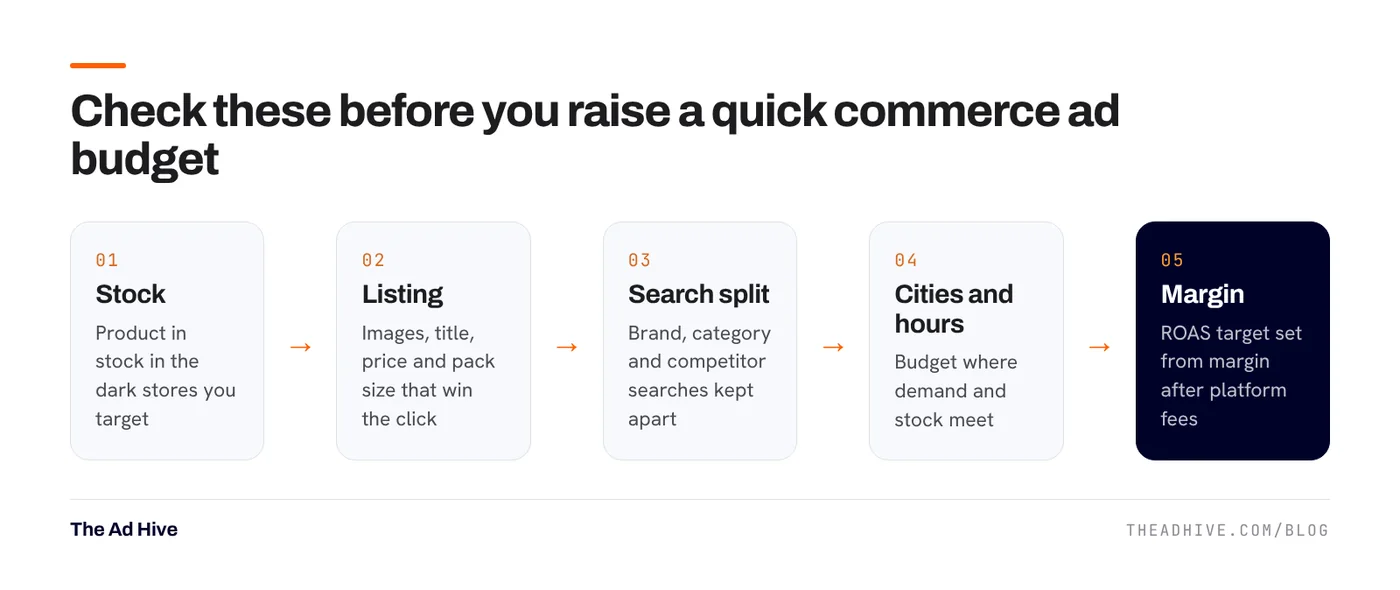
Quick commerce runs on local dark stores. If your product is out of stock in a store, shoppers near it can’t buy, whatever you spend.
- Check stock by city and dark store before you set budgets.
- Make sure the main image shows the pack clearly, even as a small thumbnail.
- Check that price and pack size compete with the products shown next to yours.
2. Pick the right ad for the job
- To capture demand: search and product ads on your category’s main searches.
- To launch a new product: banners or a brand page, plus product ads on related searches.
- To raise order value: cart and recommendation ads next to items people already buy with yours.
Give each campaign one goal. A banner judged on ROAS and a search ad judged on reach will both look like failures.
3. Plan by city and by hour
Demand on these apps is very local and very time-bound. Snacks peak at night. Breakfast items peak in the morning. Some cities buy your category far more than others.
Blinkit says advertisers can combine three targeting layers: geography (from all of India down to one city), shopper cohorts, and time of day. Use them to put budget where demand and stock meet.
4. Keep brand, category and competitor searches apart
- Brand searches (people typing your name) are cheap but often buy sales you would get anyway. Bid enough to protect the top spot, no more.
- Category searches (like “protein bar” or “face wash”) are where new customers come from. Most of the budget belongs here.
- Competitor searches can work when your product is a genuine alternative. Watch them closely.
Report these three separately. Blended together, the brand searches hide how the rest is doing.
5. Watch the money
Most quick commerce ads run from a prepaid wallet. That makes it easy to top up and forget. In June 2025, Storyboard18 reported that Zepto had auto-activated campaigns for brands that had none running, which worried brands that had paused ads on purpose.
- Give one person clear ownership of every wallet and campaign.
- Check campaign status and daily budgets every week on every app.
- Keep a written record of planned spend by app, so surprises show up quickly.
6. Judge results against your margin
Each app reports its own attributed sales and ROAS (revenue per rupee of ad spend). Those numbers are useful for steering inside one app. They don’t tell you whether you made money.
- Start with the selling price on the app.
- Take away platform commission and fees, discounts you fund, and your product and delivery cost.
- What is left, as a share of the selling price, is your margin.
- Your break-even ROAS is 1 ÷ that margin. If you keep 25% of the price, break-even ROAS is 4x.
Also track ad spend as a share of your total sales on each app, including organic sales. It works like TACoS on Amazon: if it keeps rising while total sales stay flat, ads are buying sales you would have got anyway.
Label every app’s sales figure as that app’s attributed sales, and say whether it includes returns and cancellations. Don’t add Blinkit, Zepto and Instamart ROAS to your Meta or Google ROAS in one table. Compare them through total sales and margin instead. Our ROAS vs MER vs POAS guide explains how.
How quick commerce fits with your other ads
Many people discover a product on Instagram or YouTube, then buy it on a 10-minute app that evening. If you only judge Meta on website sales, it will look worse than it is. If you only judge quick commerce on its own ROAS, it will look better than it is.
Plan the channels together. Meta and YouTube create demand. Search ads on quick commerce and Amazon capture it. Watch total sales across all of them when you change budgets, and raise spend in steps, as our scaling guide explains.
Want help running Blinkit, Zepto and Instamart ads? See our quick commerce ads agency page, or start with our D2C marketing team.
Frequently asked questions
Is there a minimum budget for Blinkit ads?
Blinkit says its self-serve platform, Brand Central, has no fixed minimum. You set a daily budget and bids and pay per click or per impression, depending on the format.
Which is better for ads: Blinkit, Zepto or Instamart?
There is no single answer. It depends on where your shoppers order, which cities you stock, and how each app's sales compare for your category. Start where your organic sales and stock are strongest, then test the others.
How do I know if quick commerce ads are profitable?
Work out your margin after platform commission, discounts and product cost. Your break-even ROAS is 1 divided by that margin. If ads bring back less than that, they lose money, even when the platform's ROAS looks high.
Sources
- Blinkit: Brand Central, Blinkit's self-serve ads platform
- Storyboard18: Zepto launches Jarvis, an in-house ad platform (25 Nov 2024)
- Storyboard18: Zepto auto-activates ad campaigns, brand partners raise concerns (4 Jun 2025)
Sources checked on 25 November 2026. Platform features change often; check the linked pages for the latest details.
Want this done on your account?
We manage Google and Meta ads for e-commerce, D2C and lead-gen brands. Every engagement starts with a manual review of what is already running.
Related guides
ACOS vs TACoS on Amazon: how to read them and set targets
ACOS tells you how efficient your Amazon ads are. TACoS tells you whether they're growing the business. Read them together and you'll know when to push…
ROAS vs MER vs POAS: which number should run your ad budget?
ROAS tells you what a platform claims. MER tells you what the business got. POAS tells you whether you made money. You need all three, used…
How to scale ad spend without breaking ROAS
Doubling the budget rarely doubles the sales. Scaling works when you add spend in steps, open new demand instead of squeezing old demand, and watch the…