A creative testing framework for Meta ads that works after Andromeda
The old way of testing Meta ads, one variable at a time in tiny ad sets, fights how Meta now delivers ads. Here is the testing system we use instead.
Key takeaways
- Test big ideas (concepts) before small details (polish).
- Near-identical ads are treated alike by Meta’s delivery. Distinct ads reach different people.
- Give each new concept fair spend before judging it.
- Creative is a pipeline, not a project. Plan new concepts every week or two.
The classic Meta testing playbook went like this: one ad set per variable, equal budgets, change one thing at a time, pick the winner. It made sense when you chose the audience yourself. It makes much less sense now that Meta’s delivery system uses the ad itself to decide who sees it.
Why the old method breaks
Meta’s ad retrieval system, Andromeda, picks candidate ads for each person using signals from the ads. Meta says the latest version scores every eligible ad. Two things follow:
- Ads that are almost the same tend to reach the same people. Testing a red button against a blue one tells you very little.
- Splitting budget into many tiny ad sets slows learning. Each one has less data to work with.
Our Andromeda explainer covers the background. This post is the practical side.
Test from the top of the ladder
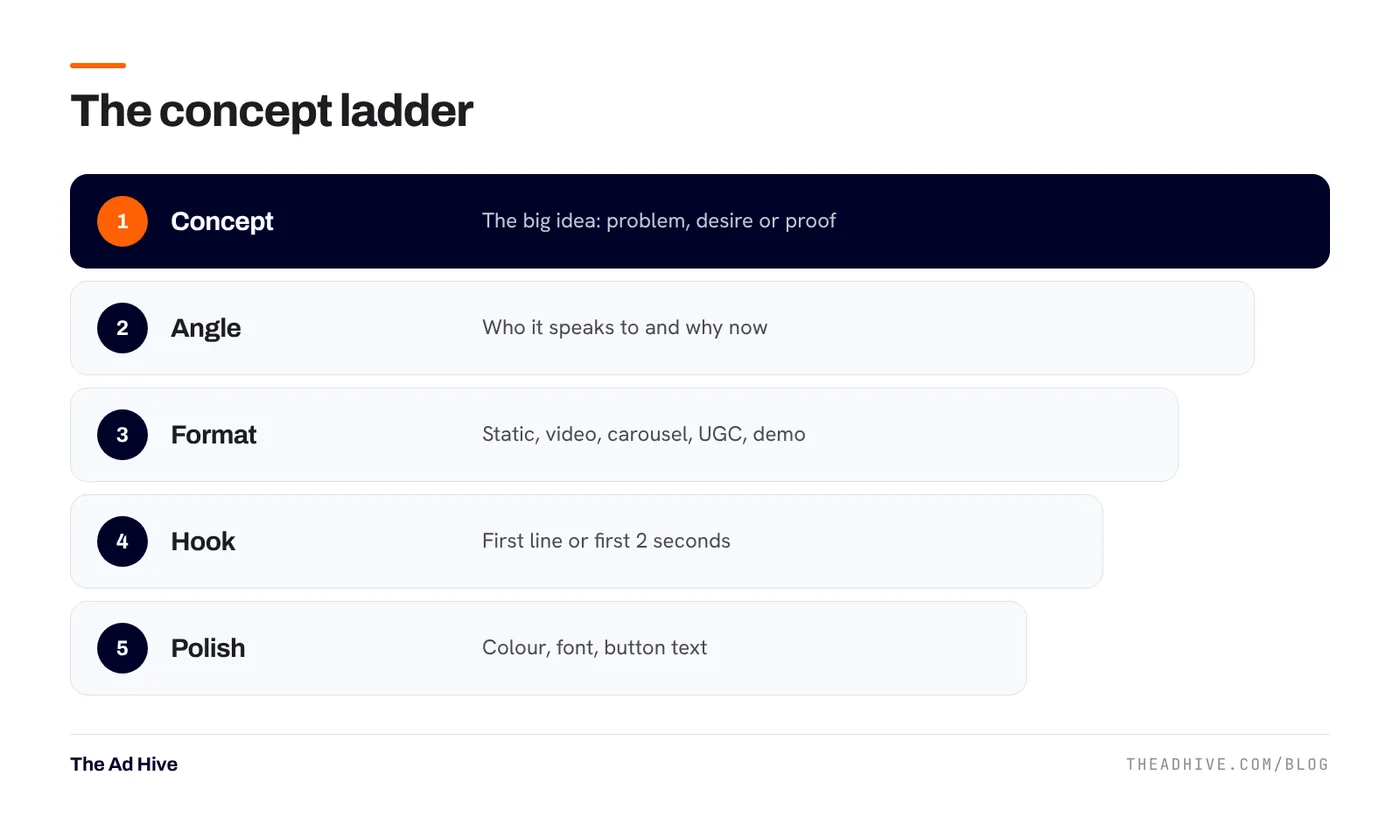
1. Concept
The core idea. Examples for a skincare brand: “fixes dull skin in two weeks”, “dermatologist-made”, “replaces three products”, “the gift she’ll actually use”. Each is a different reason to buy, and each will find different people.
2. Angle
Who it speaks to and why now. The same “replaces three products” concept can target busy professionals, new mothers or minimalists.
3. Format
Static image, short video, carousel, creator-style video, product demo, founder talking to camera. Format changes who stops scrolling.
4. Hook
The first line of text or first two seconds of video. Once a concept works, hooks are the fastest way to extend its life.
5. Polish
Colours, fonts, button text. Test these last, if at all.
The weekly testing cycle we run
- Brief 2–4 new concepts. Use customer reviews, support questions, competitor ads and sales data for ideas.
- Make 2–3 versions of each concept in different formats or hooks. Not ten.
- Launch into the main sales campaign, or a test campaign if you need a cleaner read on a big new idea.
- Wait for fair spend. A common rule of thumb is to let a new ad spend at least one to two times your target cost per purchase before judging.
- Sort into three groups: winners (keep and build hooks on), maybes (one more round) and losers (switch off).
- Write down why. A simple log of concept, angle, format and result becomes your creative playbook.
How to judge a winner
- Primary: cost per purchase or ROAS against the account target.
- Supporting: thumb-stop rate (3-second views ÷ impressions) and click-through rate show whether the hook works, even if sales are slow.
- Business check: are buyers from this ad new customers? Do they return products more often? A cheap sale that comes back isn’t a win.
Meta’s help centre explains that ad sets go through a learning phase after launch or a significant edit. Big edits to a live ad set can restart it. Add new ads in batches, not one at a time every day.
Where ideas come from
- Reviews and support tickets: the exact words customers use are often the best hooks.
- Sales data: which products, bundles and price points sell best, and to whom.
- The Meta Ad Library: what competitors keep running for months is usually working for them.
- Search terms from Google: the questions people search show what they worry about. See our search terms routine.
The same thinking works on Google
Demand Gen and Performance Max also reward distinct creative. If you’ve built a concept library for Meta, reuse it there. Our Demand Gen guide covers the format specs.
Where to run new ads? Usually inside your Advantage+ sales campaign. Need help building the pipeline? Our PPC management includes a monthly creative plan, and our audit reviews your current creative mix.
Frequently asked questions
How many creatives should I test on Meta each month?
It depends on spend. As a rule of thumb, add enough new concepts that each gets meaningful spend. For most growing D2C brands we work with, that means a few new concepts every week or two rather than dozens of tiny variations.
Should I test creatives in a separate campaign?
You can, but it is not required. Many accounts now add new ads into the main sales campaign and let delivery decide. Use a separate test campaign when you need a cleaner read on a big new idea.
When should I turn off an ad?
When it has had fair spend and clearly underperforms the account's target on cost per purchase or ROAS, or when performance of a former winner has faded for a sustained period. Don't judge on a day or two of data.
Sources
- Engineering at Meta: Meta Andromeda (2 Dec 2024)
- Engineering at Meta: Meta Andromeda next-gen ads retrieval (28 Oct 2026)
- Meta Business Help Center: About the learning phase
Sources checked on 15 November 2026. Platform features change often; check the linked pages for the latest details.
Want this done on your account?
We manage Google and Meta ads for e-commerce, D2C and lead-gen brands. Every engagement starts with a manual review of what is already running.
Related guides
Meta Andromeda explained: why your creative is now your targeting
Andromeda is the system Meta uses to pick which ads could be shown to each person. It changed what works on Meta, and many accounts felt…
Advantage+ sales campaigns: setup, existing-customer caps and when they work
Advantage+ sales campaigns (formerly Advantage+ shopping) let Meta automate audience, placements and budget in one campaign. Set up well, they are the backbone of most D2C…
Demand Gen campaigns for e-commerce: a practical setup guide
Demand Gen is Google's answer to social-style advertising: visual ads on YouTube, Shorts, Discover and Gmail. With Display moving into it from 2026, every e-commerce brand…